
Anyone who reads my blog with any regularity knows that I am a huge proponent of hands-on learning. it is truly how real learning takes place. As students put projects together, create crafts, or use familiar materials in new ways, they're constructing meaning. "Kids learn through all their senses," says Ben Mardell, PhD, a researcher with Project Zero at Harvard University, "and they like to touch and manipulate things." But more than simply moving materials around, hands-on activities activate kids' brains. According to Cindy Middendorf, educational consultant and author of The Scholastic Differentiated Instruction Plan Book (Scholastic, 2009), between the ages of four and seven, the right side of the brain is developing and learning comes easily through visual and spatial activities. The left hemisphere of the brain—the side that's involved in more analytical and language skills—develops later, around ages 10 and 11.
When you combine activities that require movement, talking, and listening, it activates multiple areas of the brain. "The more parts of your brain you use, the more likely you are to retain information," says Judy Dodge, author of 25 Quick Formative Assessments for a Differentiated Classroom (Scholastic, 2009). "If you're only listening, you're only activating one part of the brain," she says, "but if you're drawing and explaining to a peer, then you're making connections in the brain."
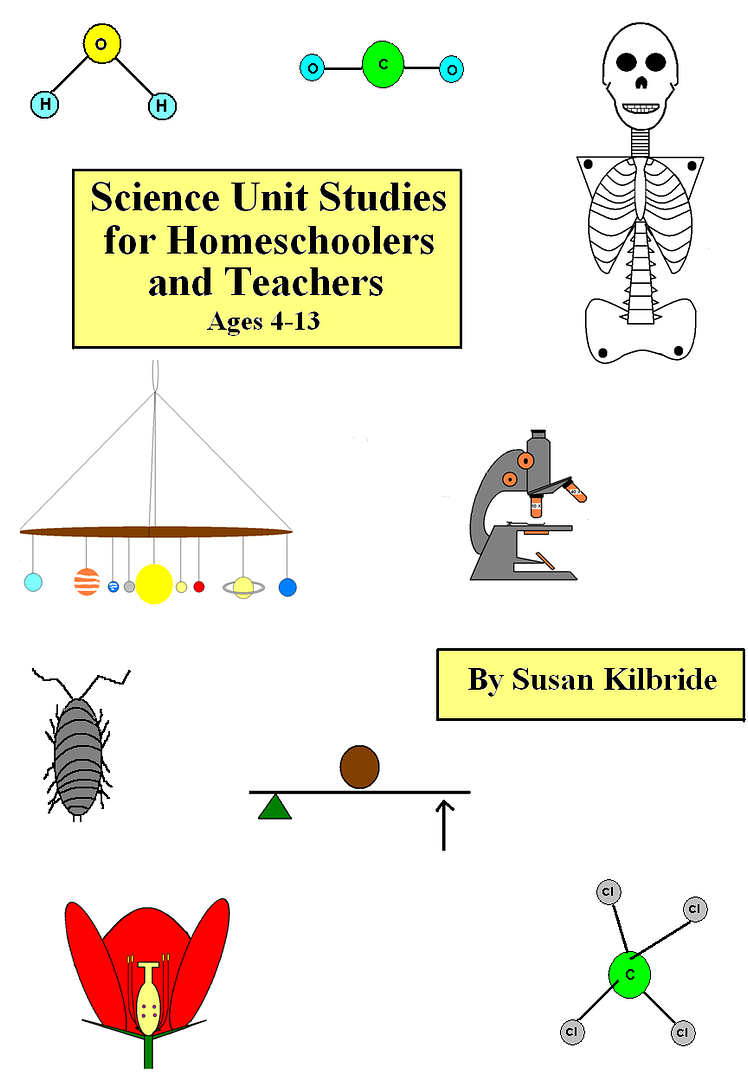
This is definitely what Susan Killeride had in mind when writing this book. It consists of twenty lessons-- ten for students ages 4 through 7 and ten for children ages 8 to 13. Both sets of lessons cover the topics of physical, earth and life sciences.
The 20 unit studies are:
- Our Senses
- The Human Body
- Dinosaurs and Prehistoric Life
- Animals
- Insects and their Kin
- Fun with Magnets
- Stars and Planets
- Health (taking care of your body)
- Beginning Plants
- Animal Ecology
- Insects
- Microscopes and Invisible Creatures
- Atoms and Molecules
- Matter
- Chemistry Fun
- Weather
- Force and Motion
- Simple Machines
- Light and Color
- Plants 2
- Answers to Tests and Worksheets
As a busy homeschool mom, I have to say that I truly appreciated that each unit beFgins with a materials list. It made it quite easy to plan and local the items ahead of doing the experiment(s). I also love the fact that the book was written by a homeschool mom (with a degree in Biology!) for homeschool moms. It is easy to understand and follow and is written in layman's terminology.
I am a history nerd. I took advanced science in school because it was required not because I had any real desire to do so. A book like this makes learning (and teaching!) science fun. Perhaps this could inspire my kids to want to take more science someday.
This 201 page book is available for only $16.95 and will provide you with the peace of mind that you indeed now have what is takes to teach a great deal of science while simultaneously allowing your children to thrive in a hands-on environment that will have them asking for more.
Why not see it yourself? Here are links to pages that have two free PDF units from the book:
Here is another link that has some other available freebies:
The photo below is Kiddo #3 with the plants (hopefully soon to be flowers) that grew from the sunflower seeds that he planted. Our entire garden this year, in fact, was started from seed. What a great learning (and eating!) experience it has been. You can see Kiddo #4 with one of our home-grown cucumbers.

For Microscopes and Invisible Creatures, we went to our local nature center and were able to use small containers to pull some water from the pond. Boy, were the Kiddos surprised when we looked under the microscope at what looked like "clear" water:


We are really looking forward to doing more of the units in this book as our new school year begins. Keep checking back here. I'm sure to blog all about our adventures.


Don't miss a thing! Subscribe to Home to 4 Kiddos by Email and get our posts sent right to your inbox!
